E-commerce Payment Solution
Everything you need to know about Apple Pay - the secure, private payment solution designed for Apple's ecosystem of devices.
What is Apple Pay?
Apple Pay is a mobile payment and digital wallet service by Apple Inc. that allows users to make payments in person, in iOS apps, and on the web. It digitizes and replaces the credit or debit card chip and PIN transaction at credit card terminals. Launched in 2014, Apple Pay has grown to become one of the most popular contactless payment systems in the world.

Apple Pay uses Near Field Communication (NFC) technology for contactless payments in stores, and Touch ID, Face ID, or device passcode for authentication. For online purchases, it provides a streamlined checkout experience without requiring users to manually enter card details for each transaction.
How Apple Pay Works
Apple Pay utilizes a secure element chip in Apple devices to store encrypted payment information. When a user adds a card to Apple Pay, the actual card numbers are not stored on the device or on Apple servers. Instead, a unique Device Account Number is assigned, encrypted, and securely stored in the Secure Element.
Setting Up Apple Pay
Integrating Apple Pay into your e-commerce platform involves these steps:
- Register as an Apple Developer (if not already)
- Obtain a Merchant ID from Apple Developer Portal
- Create Apple Pay certificates
- Integrate Apple Pay JS API with your website
- Configure your payment gateway to support Apple Pay
- Test transactions using the sandbox environment
- Submit your implementation for Apple review
- Go live and start accepting Apple Pay transactions
Key Apple Pay Statistics
- Available in 60+ countries and regions worldwide
- Over 500 million active users globally
- Accepted by 85% of retailers in the United States
- 70% higher conversion rates compared to traditional checkout
- Supported by 6,000+ banks and credit unions
- Processes over 1 billion transactions monthly
Apple Pay Core Features
Apple Pay offers a comprehensive suite of features designed with security and privacy in mind:
Secure Authentication
Uses Face ID, Touch ID, or device passcode for transaction authorization.
Tokenization
Replaces card details with unique tokens for each transaction.
Privacy Protection
Apple doesn't store or have access to original card numbers.
Multi-Device Support
Works on iPhone, Apple Watch, iPad, and Mac.
In-App Payments
Seamless checkout experience within iOS applications.
Browser Integration
Works with Safari on both macOS and iOS devices.
Loyalty Cards
Supports storing and using loyalty and rewards cards.
Recurring Payments
Supports subscription-based business models.

Payment Methods Supported by Apple Pay
Apple Pay supports various payment methods depending on the user's country and bank:
Credit Cards
Visa, Mastercard, American Express, Discover, JCB, and UnionPay.
Debit Cards
All major debit card networks supported.
Prepaid Cards
Supported prepaid cards from participating issuers.
Store Cards
Select retail store credit cards.
Apple Pay Fees and Pricing
One of Apple Pay's main advantages is its pricing structure for merchants:
Transaction Fees
| Transaction Type | Fee Structure | Notes |
|---|---|---|
| Physical Goods & Services | No additional fee | Merchants pay standard payment processing fees only |
| Digital Goods (App Store) | 15-30% service fee | For apps selling digital goods through App Store |
| Peer-to-Peer Payments | No fee | For Apple Cash transactions between users |
| International Transactions | Standard FX fees apply | Typically 0.5-1% currency conversion fee |
Additional Costs
| Service | Cost | Notes |
|---|---|---|
| Payment Gateway Fees | Varies by provider | Standard credit card processing rates apply |
| Chargebacks | Varies by provider | Standard chargeback fees from payment processor |
| Apple Developer Program | $99/year | Required for merchant implementation |
| Monthly Maintenance | Free | No recurring fees for Apple Pay specifically |
Pro Tip
Apple Pay doesn't charge additional processing fees for most transactions—merchants only pay their standard payment processing fees. This makes it one of the most cost-effective digital wallet solutions available. The primary investment is the $99/year Apple Developer Program fee, which offers many other benefits beyond just Apple Pay integration. The real value comes from increased conversion rates and reduced cart abandonment, particularly among high-value Apple users.
Countries Where Apple Pay Is Available
Apple Pay is currently available in these countries and regions:
North America
United States, Canada, Mexico
Europe
UK, Germany, France, Italy, Spain, Netherlands, Sweden, Belgium, Denmark, Portugal, Poland, Ireland, Austria, Switzerland, Norway, Finland, Ukraine, Czech Republic, Hungary, Greece, Luxembourg, Iceland, Isle of Man, Jersey, Guernsey
Asia-Pacific
Australia, New Zealand, Japan, China, Hong Kong, Taiwan, Singapore, Macau, Kazakhstan, Georgia, Armenia, Azerbaijan, Israel, UAE, Saudi Arabia, Qatar, Bahrain, Jordan, Kuwait, Palestine
Other Regions
Brazil, Colombia, Chile, Peru, Argentina, Costa Rica, South Africa, Mauritius
Important Consideration
While Apple Pay is available to merchants in many countries, buyer availability may differ. Customers must have a compatible Apple device and be in a supported country to use Apple Pay. Additionally, some banks may not support Apple Pay in all regions. Always check Apple's official website for the most current list of supported countries, banks, and features.
Apple Devices Supporting Apple Pay
iPhone
iPhone 6 and later
Apple Watch
All models
Mac
2012 models and later with Touch ID or iPhone/Watch
iPad
iPad Pro, iPad Air 2, iPad mini 3 and later
Industries Benefiting from Apple Pay
Apple Pay is particularly effective for these types of businesses:
Retail E-commerce
Businesses selling physical products that benefit from streamlined mobile checkout experiences.
Digital Products and Services
Companies offering apps, digital content, streaming services, or software subscriptions.
Travel and Hospitality
Booking platforms for hotels, flights, and experiences where mobile optimization is crucial.
Food Delivery and Restaurants
Quick-service restaurants and delivery platforms where fast checkout is essential.
Luxury Goods
High-end retailers whose customers disproportionately use Apple devices.
Apple Pay vs. Other Payment Gateways
How Apple Pay compares to other popular options:
| Feature | Apple Pay | Google Pay | PayPal | Amazon Pay |
|---|---|---|---|---|
| Platform Availability | Apple ecosystem only | Android, iOS, Web | All platforms | All platforms |
| Additional Fees | None | None | Varies | Standard processing |
| User Base | 500M+ | 150M+ | 400M+ | 300M+ |
| Security Features | Excellent | Excellent | Good | Good |
| International Reach | 60+ countries | 45+ countries | 200+ countries | 20+ countries |
| User Demographics | Higher income | Broad | Broad | Amazon shoppers |
Setting Up and Managing Apple Pay
Apple Pay offers several integration options for merchants:
Integration Options
Apple Pay can be integrated through various methods:
E-commerce Platforms
Pre-built plugins for Shopify, WooCommerce, Magento, and others.
API Integration
Direct API integration for custom-built platforms.
Payment Service Providers
Integration through partners like Stripe, Braintree, and Adyen.
Payout Schedule
Funds are processed according to your payment gateway's schedule, typically within 1-3 business days.
Security Features
Apple Pay uses multiple security layers including tokenization, encryption, and biometric authentication.
Reporting
Transaction reporting is available through your payment gateway dashboard.
Security and Privacy Features
Apple Pay employs industry-leading security measures:
Tokenization
Replaces card details with unique device-specific tokens
Biometric Authentication
Face ID or Touch ID required for all transactions
Secure Element
Dedicated chip in Apple devices stores payment data
Privacy Focus
Apple doesn't know what you buy or where you buy it
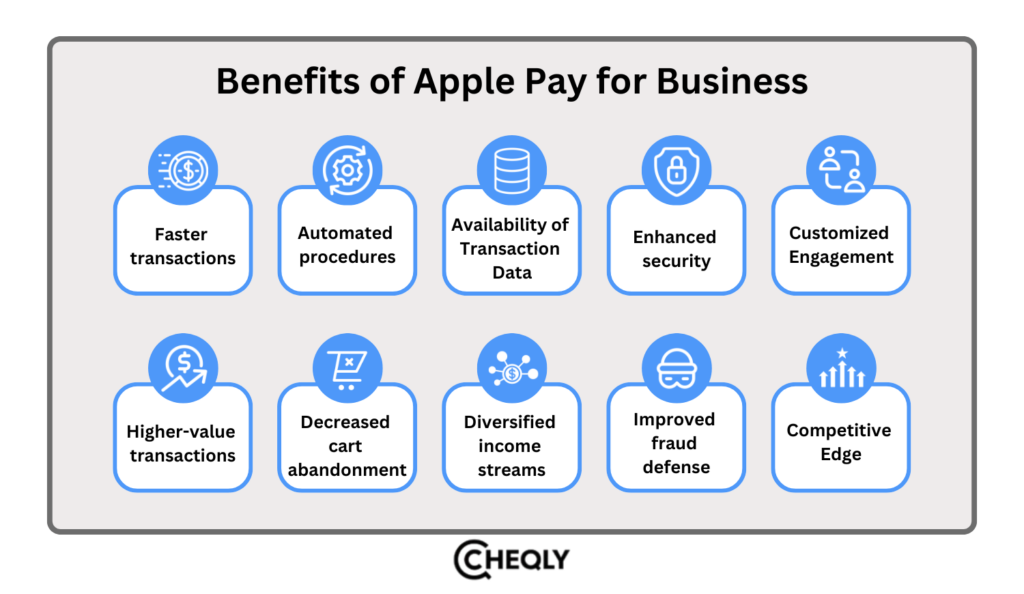
Benefits of Apple Pay for Merchants
Higher Conversion Rates
Streamlined checkout process can increase conversion rates by up to 70% compared to traditional checkout methods.
Cost Effective
No additional transaction fees mean you can offer a premium payment experience without increasing costs.
Premium Demographics
Apple users typically have higher disposable income and spending power.
Reduced Fraud
Tokenization and biometric authentication significantly reduce fraud risk.
Future of Apple Pay
Apple continues to enhance its payment offerings:
- Expansion to new countries and regions
- Apple Card integration and expansion
- Enhanced business payment features
- Improved loyalty and rewards programs
- Better analytics and reporting tools for merchants
- More features for in-person payments
- Integration with other Apple services
Final Recommendation
Apple Pay is an excellent payment solution for e-commerce merchants, particularly those targeting affluent demographics or selling premium products. With no additional transaction fees and industry-leading security features, it offers a strong return on investment. While limited to Apple's ecosystem, this audience typically has higher conversion rates and average order values. For businesses with significant mobile traffic—especially from iOS devices—implementing Apple Pay can significantly reduce cart abandonment and increase revenue. Consider implementing Apple Pay alongside other payment options to maximize conversion opportunities across all customer segments.

0 Comments
Comment your problems without sing up